
If you camp, full-time live, or seasonally park an RV anywhere between Key West and Key Largo, you already know the Florida Keys aren’t easy on vehicles. The combination of relentless salt air, intense UV radiation, and near-constant humidity creates an environment that degrades unprotected exterior surfaces faster than almost anywhere else in the continental United States.
One of the most common questions our team gets: “How often should I really be washing my RV down here?”
The honest answer is: more often than you think — and it’s not just about keeping things looking clean.
Why the Florida Keys Are Different From Everywhere Else
Most RV care guides are written for the continental interior — dry climates, seasonal use, a rinse here and there. The Florida Keys operate by entirely different rules.
Salt air is everywhere. Even if your RV never parks near the water, the Keys’ marine environment means salt particles are suspended in the air year-round. Those particles settle on every surface: your fiberglass panels, your gel coat, your painted aluminum, your window frames. When they stay long enough, they start reacting chemically with your exterior.
UV intensity is extreme. Key West sits just 90 miles from the Tropic of Cancer. The sun isn’t just warm here; it’s punishing. UV radiation breaks down oxidation-prone coatings, fades paint, chalks fiberglass, and dramatically accelerates any damage already started by salt.
Humidity never really drops. Even in the dry season, relative humidity in the Keys rarely dips below 60%. That moisture layer traps contaminants against your surface, creating a perfect storm for corrosion, mold growth on rubber trim, and finish degradation.
So when you ask “how often should I wash my RV?” — the answer must account for this environment specifically.
The Wash Frequency Guide for Florida Keys RVs
Coastal / Waterfront Parking (Marina, Canal, Oceanside)
Wash every 7–10 days.
If your RV is parked within a quarter mile of open saltwater — a marina, a canal-side site, or a beachfront park — you’re in the highest-exposure zone. Salt spray is direct and constant. At this frequency, you’re actively rinsing contaminants before they have time to bond to your surface.
Miss a wash cycle, and you’ll start to see white, hazy salt deposits forming. Let those sit for 3–4 weeks, and you’re looking at etching that no amount of washing can reverse — you’ll need a machine polish or a full paint correction.
Inland or Sheltered Sites (Campgrounds, Resorts, Storage)
Wash every 14 days minimum; every 10 days in summer.
Even sheltered from direct spray, salt is still in the air. Summer adds tropical storm moisture, elevated temperatures, and heavier UV intensity — all of which accelerate the problem. A biweekly wash cycle keeps you ahead of buildup.
Seasonal / Occasional Use (Snowbird or Part-Time Use)
Wash immediately upon arrival, then every 14 days during your stay — and do a full detail before storage.
Many of our clients are seasonal snowbirds who park for 2–5 months. The biggest mistake: arriving with a “road dusty” RV from the drive down, then leaving it parked without washing. That road grime combines with Keys salt and bakes onto the surface. Wash within 24–48 hours of arrival, maintain a 14-day cycle, and schedule a professional detail + protection service before you head back north.
What “Washing” Actually Means — It’s Not Just a Garden Hose
A garden hose rinse might feel like you’re cleaning your RV, but in a salt-air environment, it often does more harm than good. Here’s why.
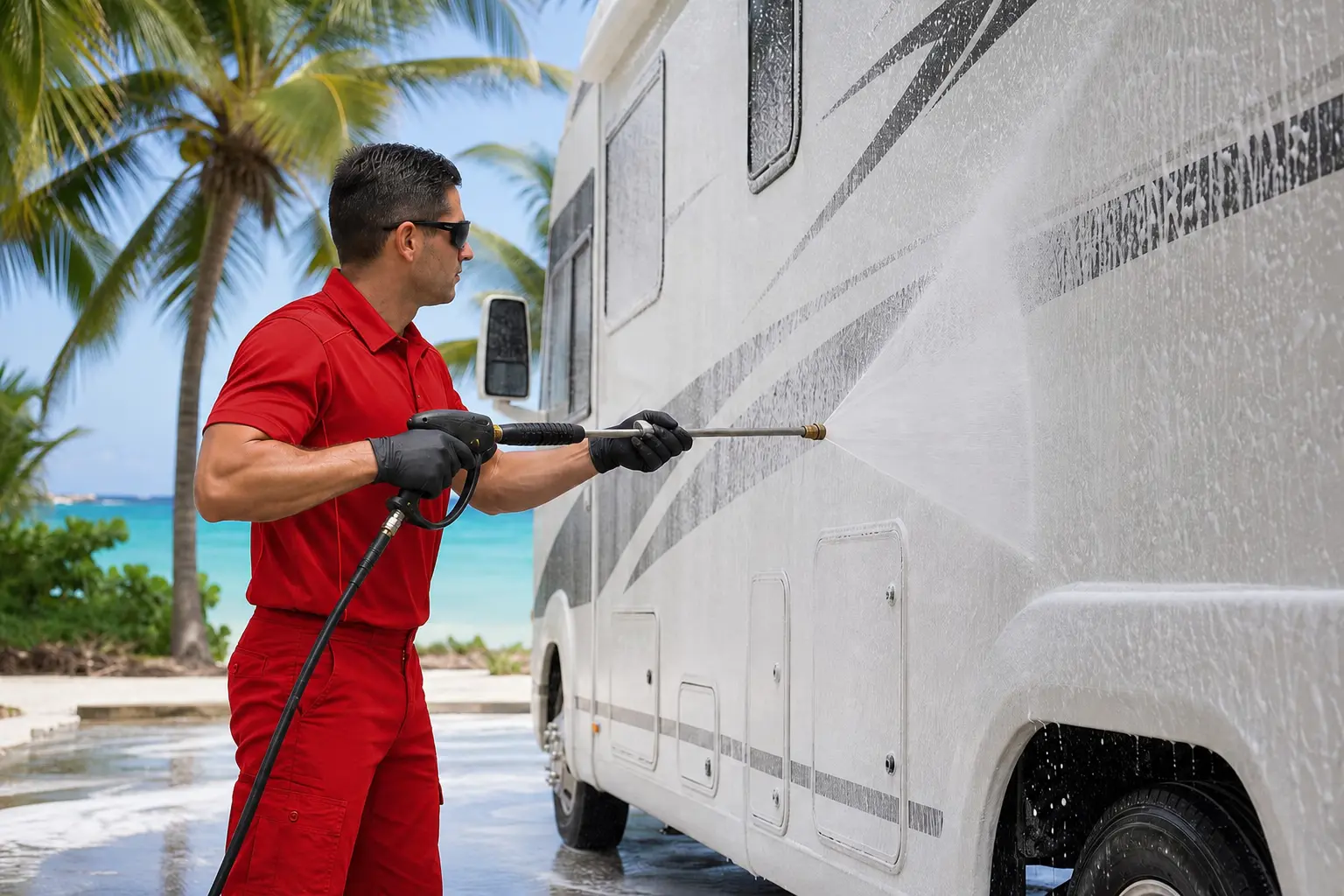
Low water pressure doesn’t remove bonded salt. Dissolved salt and road film require a proper foam cannon or pressure wash to break loose from surface pores. A casual rinse moves loose debris but leaves the damaging stuff behind.
Hard water from the hose leaves mineral deposits. Tap water in South Florida is notoriously hard. Without a proper final rinse and drying technique, you’re trading salt deposits for calcium streaks.
Improper drying creates water spots. In Keys’ humidity, letting your RV air-dry after a wash almost guarantees water spot etching — especially on glass and clear-coat panels.
A proper professional RV wash includes:
– Pre-rinse to loosen surface deposits
– pH-balanced foam cannon wash
– Hand-wash with soft microfiber or lamb’s wool
– Spot-free pressure rinse
– Hand-drying with quality microfiber towels
This is the level of care your RV needs to genuinely benefit from a wash — not just look briefly cleaner.
When You Should Call the Professionals
Between washes, there are specific situations where a DIY approach simply won’t cut it:
After a tropical storm or heavy rain event, storm surge and heavy rain carry concentrated salt and debris that can coat your entire exterior in hours. A professional post-storm wash within 24–48 hours prevents accelerated damage.
When you notice chalking or oxidation, white, hazy, or powdery patches on fiberglass indicate UV oxidation. This requires machine polishing — not more washing — before any protective coating goes on.
Before applying or refreshing the ceramic coating. Ceramic coatings (like the Liquid Armour systems we apply) require a surgically clean surface. Any contamination left beneath the coating is locked in — and defeats the purpose. Always schedule a professional detail prep before any coating application.
If you haven’t washed in 30+ days. At this point, you likely have bonded contamination that requires a clay bar or chemical decontamination step, not just a soap wash.
The Compound Effect: What Skipped Washes Actually Cost You
Here’s the math most RV owners don’t do until it’s too late:
- Skipping 2 washes = light salt haze, easily remedied with a good wash
- Skipping 4–6 washes = bonded salt + oxidation beginning, requires polish (~$200–$400 extra)
- Skipping a full season = deep oxidation, potential gel coat damage, possible clear coat failure — full exterior restoration cost ranges from $800–$2,500+, depending on RV size
- Deferred ceramic coating = significantly higher prep labor cost as damage compounds
The cost of a regular professional wash cycle is a fraction of restoration work. More importantly, consistent maintenance preserves resale value. A well-maintained RV exterior in the Florida Keys commands thousands more at resale than a neglected one.
How Ceramic Coating Changes the Equation
One of the best things you can do to make washing easier — and necessary less frequently for deep cleans — is to apply a professional ceramic coating.
Here’s what changes:
A hydrophobic surface sheds water and contaminants. On an unprotected surface, water and salt bond aggressively. On a ceramic-coated surface, water beads and rolls off — pulling surface contaminants with it. Each rinse cycle is dramatically more effective.
UV resistance slows oxidation. The silica layer in a quality ceramic coating reflects UV rather than absorbing it. That means slower oxidation, reduced chalking, and preserved color depth between maintenance washes.
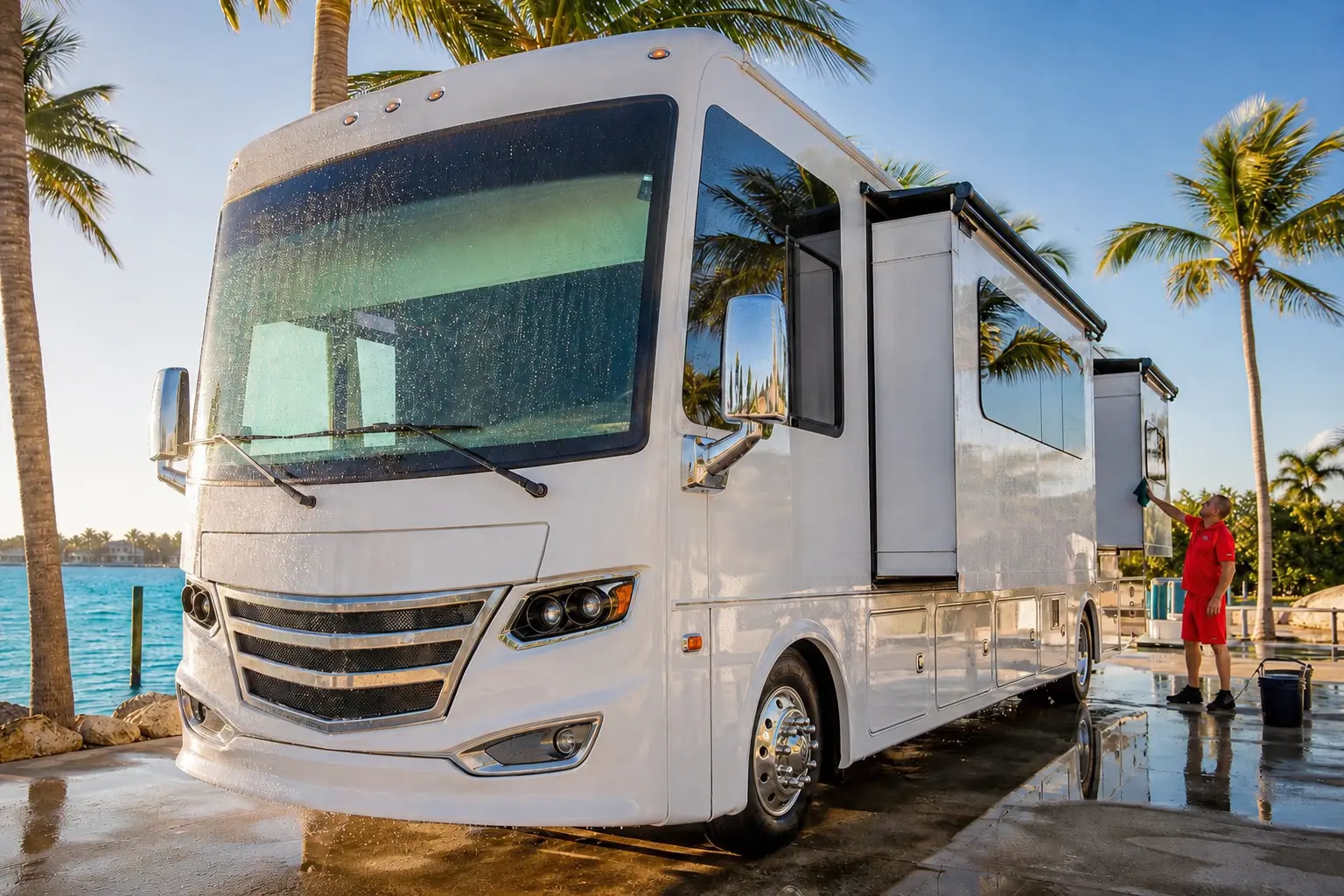
Easier maintenance washes. Salt that would normally require significant agitation to remove often rinses off a coated surface with minimal effort. Many of our ceramic coating clients report cutting wash time nearly in half.
Longer intervals between professional details. With a quality coating properly applied, you can typically extend professional detail cycles from every 90 days to every 6 months or longer — without sacrificing protection.
We use Liquid Armour ceramic coating systems, specifically formulated for Florida’s extreme UV and marine environments. If your RV doesn’t have ceramic protection yet, it’s worth understanding what it would mean for your maintenance schedule and long-term finish quality.
A Practical Wash Schedule for Florida Keys RV Owners
Here’s a simple framework to follow:
| Situation | Wash Frequency | Professional Detail |
|---|---|---|
| Waterfront/marina parking | Every 7–10 days | Every 90 days |
| Inland campground, Keys | Every 14 days | Every 90–120 days |
| Seasonal use (snowbird) | Every 14 days during stay | Full details on arrival + before departure |
| Ceramic-coated surface | Every 14–21 days | Every 6 months |
These are minimums — in summer (May–September), shorten the interval by 20–30% due to elevated UV and storm activity.
We Come to You — Serving the Entire Florida Keys
Here’s the thing about RV care in the Keys: it shouldn’t require you to haul your rig across town or wait for a shop to have availability. Our mobile RV wash and detailing service brings professional-grade equipment directly to your campsite, storage facility, or driveway.
We serve the entire Florida Keys — from Key West to Key Largo — including Key West, Stock Island, Big Pine Key, Marathon, Duck Key, Islamorada, Tavernier, and everywhere in between.
No towing required. No scheduling around shop hours. We work around your schedule, at your location, with professional results.
Ready to Protect Your RV the Right Way?
Don’t wait for salt damage to force your hand. A consistent wash schedule — combined with professional protection — is the smartest investment you can make in your RV’s long-term condition and value.
Ready to get started? Call Leoserve at 305-501-8681 or visit leoservecleaning.com to schedule your mobile service — Key West to Key Largo.
Have questions about ceramic coating, wash packages, or what’s right for your specific rig? Check out our FAQ page or reach out directly — we’re happy to talk through your situation.