
A thorough DI-water rinse removes loose grit and begins to rehydrate black-streak residue before targeted cleaning or contact cleaning starts.
Black streaks on an RV sidewall are one of the most visible signs that the exterior needs attention. In the Florida Keys, the combination of high humidity, salt air, tropical rainfall, and strong UV accelerates the conditions that cause those streaks to form and deepen. Leaving them in place through a Keys summer can allow residue to bond more firmly to fiberglass, gel coat, or painted surfaces, making the next cleaning more involved.
Leoserve’s RV wash process uses deionized (DI) water for the pre-rinse and final rinse. The technician selects the cleaning solution for the specific streak residue, RV surface, and debris present. Contact cleaning then uses tools appropriate for the specific RV surface — including a soft wash brush on suitable broad exterior panels. Brushes are reserved for RV work and are not used on car paint.
Quick Summary
- RV black streaks form when roof runoff carries dirt, oxidation, mildew, and environmental residue down the sidewall.
- Florida Keys humidity, salt air, and UV cause streaks to form faster and bond more firmly than in drier climates.
- Always inspect the roof, gutters, seams, and sidewalls before washing.
- Begin with a DI-water rinse to remove loose grit before targeted or contact cleaning.
- Use a cleaning solution selected for the streak residue, the RV surface, and the debris present; no single soap treatment resolves every condition.
- A clean soft-bristle brush is appropriate on suitable broad RV exterior panels; it is not used on car paint.
- Finish with a DI-water rinse and inspect trim, seams, lights, and lower panels before parking the RV.
What Causes Black Streaks on an RV
Most RV black streaks originate at the roof. When rainfall, condensation, or dew runs off the roof, it carries accumulated dirt, oxidized rubber or roof membrane material, mildew, algae, and any debris sitting near roof edges, vents, or air conditioner bases.
That runoff flows down the sidewall in the same paths each time, gradually depositing a dark layer that dries and bonds with exposure to sun and heat.
The Florida Keys environment intensifies this process. High relative humidity encourages mildew and algae growth on roof surfaces between washes. Salt particles in the air contribute to the film that the next rainfall carries downward. Strong UV breaks down surface sealants around vents, roof seams, and slide-out edges, creating new residue that joins the next wash cycle. An RV parked through a Keys wet season can develop streaks after a single heavy rain.
Inspect the Roof and Sidewall Before Washing
Before rinsing or touching the surface, inspect the RV from ground level for signs that the wash process needs to account for specific conditions. Look for lifted roof sealant, open vent covers, loose trim pieces, damaged light lenses, or cracked slide-out weather stripping. These areas can let water in during a wash if they are not noted and worked around carefully.
Also look at the pattern of the streaks. Uniform streaks running from roof edges are typical roof-runoff marks. Isolated dark patches near seams or fittings may indicate a leak path or accumulated mildew from a specific source. The inspection identifies what the wash will address and what may require attention from an RV repair professional rather than a cleaning process.
Start With a DI-Water Rinse A thorough DI-water rinse is the correct first step. It removes loose dust, salt film, dried environmental residue, and any grit sitting on top of the streak layer before any contact tool touches the sidewall. Working from the roofline downward, the rinse also begins to rehydrate the streak deposits and reveal which marks are loose surface buildup and which have bonded more firmly to the substrate.
Avoid beginning contact cleaning before rinsing. Grit and dried residue dragged across an RV sidewall during a dry or semi-dry contact stage can cause unnecessary surface abrasion. The time spent rinsing thoroughly is a direct investment in the quality and safety of the contact cleaning step that follows.
Targeted Cleaning Solutions Address Streaks, Surfaces, and Debris
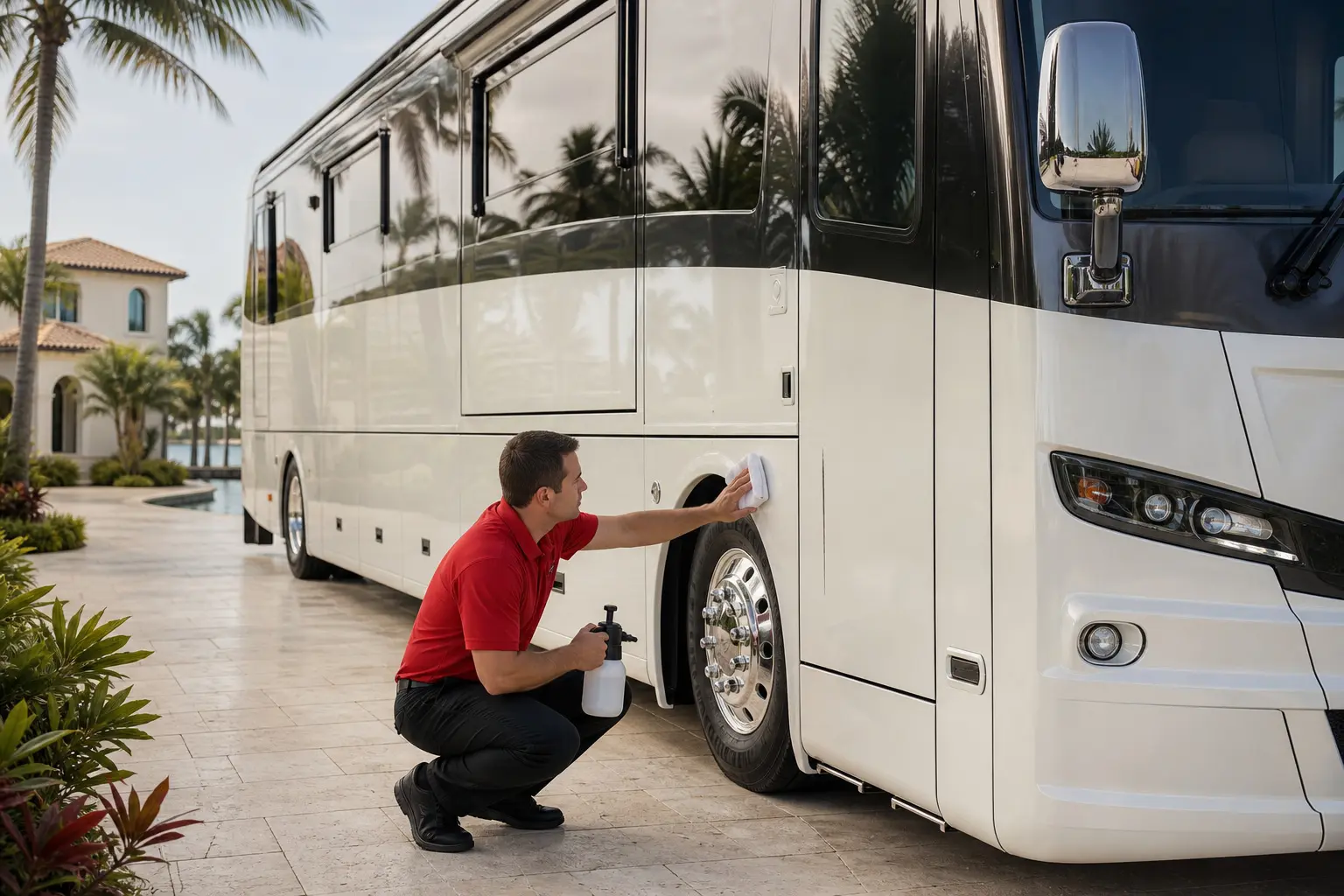
Leoserve addresses each streak, surface, and type of debris independently, using the cleaning solution appropriate to the condition and material.
After the initial DI-water rinse, Leoserve evaluates the residue, surface, and debris in each section. Black streaks, roof-runoff residue, oxidation film, mildew, road spray, tire debris, and other deposits are addressed with a cleaning solution appropriate to that condition and the RV material. No single soap treatment is presented as a solution for every streak or surface condition.
In Florida Keys heat, any applied cleaning product is worked in manageable sections and kept from drying on the surface. Heavier deposits may need a targeted treatment or repeat application rather than more pressure from a contact tool. The goal is to let the appropriate cleaning chemistry do the work before the surface is touched.
When an RV-Safe Soft Brush Is Appropriate
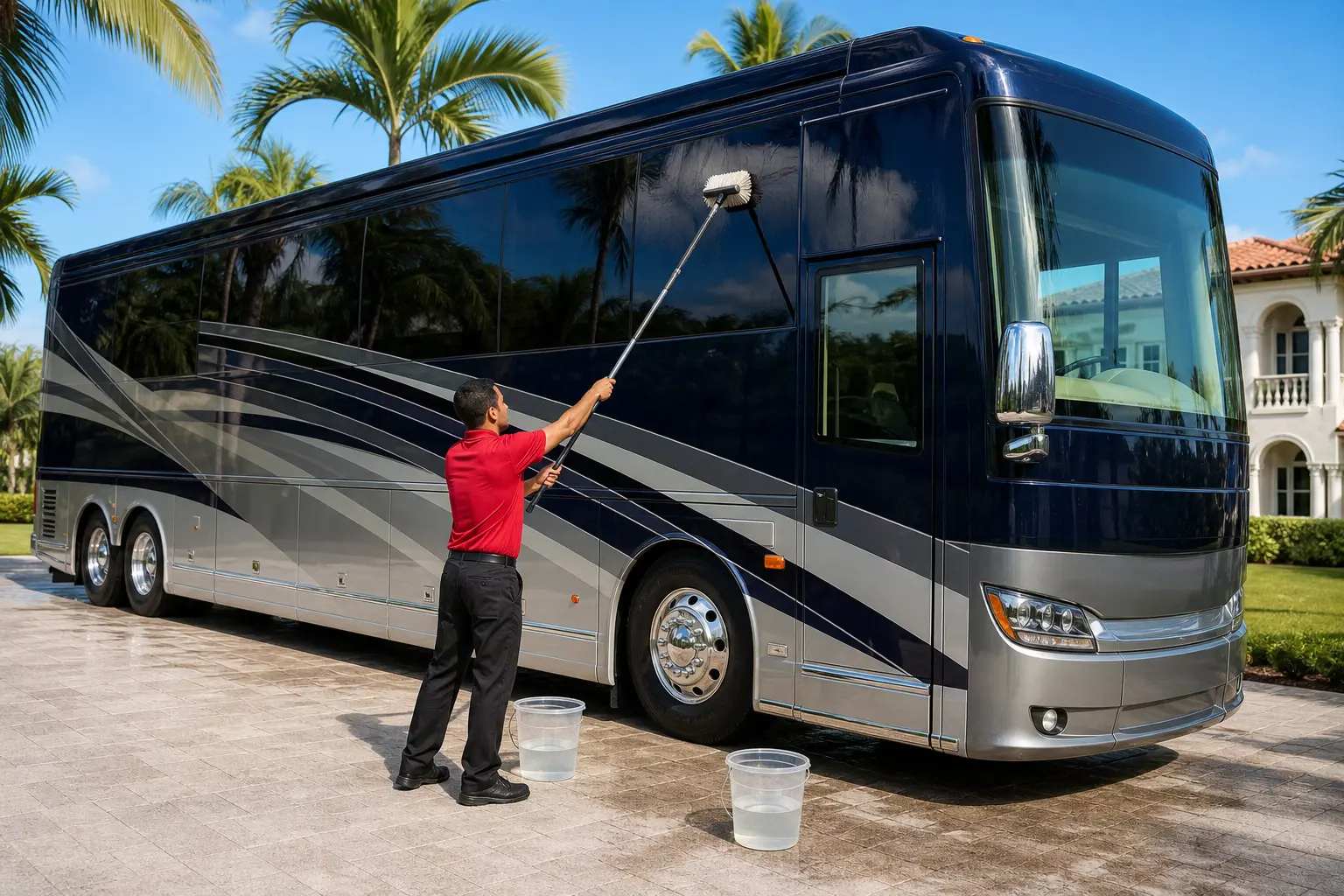
On broad, suitable RV exterior panels, a clean soft-bristle brush used with sufficient soap and rinsed frequently can reach upper sidewall areas a hand pad alone cannot.
This tool is reserved for RV surfaces only — it is never used on car paint.
Large RV sidewalls present a contact-cleaning challenge that a hand wash pad alone may not fully address, particularly on tall upper panels and broad gel-coat or painted surfaces above the waterline. On suitable RV exterior surfaces, a clean soft-bristle wash brush — used with a pH-neutral solution, rinsed frequently, and moved with steady, even pressure — is an appropriate contact tool for reaching and removing streak residue.
That is an RV-specific process. Leoserve does not use brushes on car paint; car exteriors are hand-washed with a wool wash pad, mitt, or car-safe sponge. Even on an RV, delicate graphics, decals, damaged finishes, windows, lights, and trim transitions require a different tool or a lighter hand. The brush is used on broad fiberglass or painted RV panels where it is well lubricated and appropriate to the surface condition.
Seams, Trim, and Detail Areas Need Separate Attention
Streak residue tends to concentrate near the edges and transitions that guide roof runoff: around roof sealant beads, at the tops of slide-outs, along the upper edge of body graphics or stripes, near light housings, mirror mounting points, and above baggage- door frames. These areas often need closer contact cleaning with a smaller, softer tool than the approach used on the main sidewall panels.
The lower section of the sidewall collects a different type of contamination — road spray, tire debris, water splash — on top of or beneath streak runoff. Lower panels should be treated as their own section and handled after the upper and mid-sidewall work is complete, so that debris from the lower zone is not carried upward.
Final DI-Water Rinse and Inspection
A DI-water final rinse across the full sidewall removes cleaning-solution residue and loosened contamination. DI water supports a cleaner result across the RV’s large exterior surface because it reduces the mineral deposits that ordinary water leaves as it evaporates from fiberglass, windows, lights, trim, and mirror housings.
After rinsing, inspect the sidewall carefully. Some streak marks that appeared solid during washing may become visible again as the surface dries, particularly where they have been building over multiple cycles. Areas that remain dark after a thorough wash- and-rinse sequence may indicate a condition beyond ordinary surface contamination — oxidation, staining, or substrate damage — that should be assessed separately from the wash result.
How Often Should RV Streaks Be Addressed in the Florida Keys
There is no fixed interval that fits every RV and every Keys parking situation. An RV stored under a shade structure that is washed after every trip will accumulate fewer and lighter streaks than one parked in open sun through the rainy season and washed only occasionally. The practical guide is inspection: check the sidewalls after any period of rain, significant travel, or extended outdoor storage and wash before the accumulated layer has had time to bond through repeated heat cycles.
For RVs without regular maintenance service, a full detail every 2–3 months addresses exterior accumulation alongside interior cleaning, which a wash alone does not cover.
The interval may shift based on the RV’s parking conditions, how often it travels, and how much roof runoff it generates in current condition. Inspecting regularly is more reliable than following a calendar alone.
Mobile RV Washing Across the Florida Keys
Leoserve provides mobile RV washing and detailing across the Florida Keys from its Stock Island base. The service is built around the size, finish, current condition, and parking situation of the motorhome. A mobile appointment can be scheduled at the RV’s location rather than requiring a drive to a shop, which is especially useful for larger motorhomes that are not easy to move frequently.
Review Leoserve’s mobile RV wash and detailing service at https://leoservecleaning.com/services/mobile-rv-wash-detailing/ or contact Leoserve at 305-501-8681 through https://leoservecleaning.com/about/contacts/ to request an estimate. Airstream owners can also review https://leoservecleaning.com/airstream/ for service information.
Frequently Asked Questions
What causes black streaks on an RV sidewall?
Most black streaks form when roof runoff carries accumulated dirt, mildew, oxidized roof material, and environmental debris down the sidewall. In the Florida Keys, humidity, salt air, and UV accelerate the accumulation on the roof and the bonding of streaks on the sidewall.
Can a soft brush be used on an RV to remove black streaks?
Yes, a clean soft-bristle wash brush is appropriate on suitable broad RV exterior panels when used with enough pH-neutral solution and rinsed frequently. Brushes are reserved for RV surfaces only and are not used on car paint. Delicate graphics, lights, windows, and trim still require a softer approach.
Does the DI-water rinse actually matter for an RV exterior?
Yes. DI water removes the mineral content that ordinary water deposits as it evaporates from a large fiberglass, glass, and trim surface. A DI-water pre-rinse also rehydrates dried residue before contact cleaning, and the DI final rinse reduces spotting across windows, mirror housings, lights, and upper panels.
Should black streaks be scrubbed dry before washing?
No. Begin with a DI-water rinse to remove loose grit and rehydrate the streak layer before any contact tool is used. Dry scrubbing can drag grit and residue across the surface and cause unnecessary abrasion on fiberglass or painted panels.
How often should an RV be washed to control streak buildup in the Florida Keys?
Inspect the sidewalls after rain, travel, or extended outdoor storage and wash before accumulated residue has had time to bond through heat cycles. The right interval depends on the RV’s parking conditions and how much roof runoff it generates. Without regular maintenance service, a full detail every 2–3 months keeps exterior and interior surfaces at a proper baseline.